

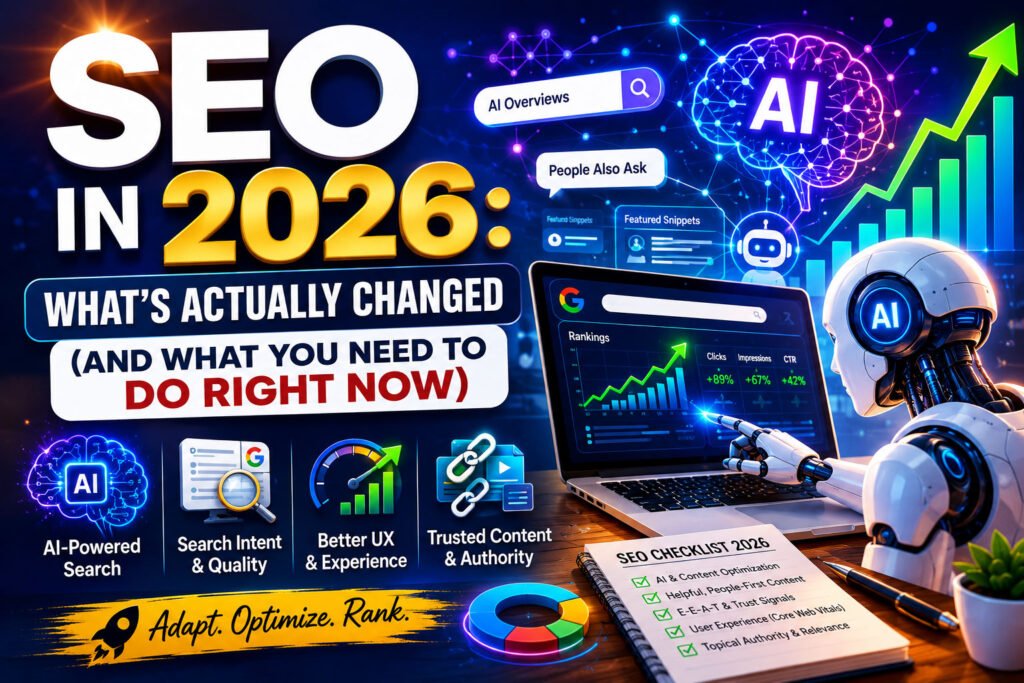
The no-fluff, no-jargon guide for business owners, marketers, and founders who want their websites to actually show up in 2026
Google Changed Everything. Again.
Imagine this: You spent the last two years doing everything right. You published blogs every week. You built backlinks. You had someone “do your SEO.” And then one morning, your traffic dropped by 40% overnight.
No penalty. No warning. Just… gone.
This is the reality for thousands of business owners in 2026. Google’s AI-powered search overhaul has rewritten the rules of ranking — and most people are still playing by the old ones.
The good news? The businesses that understand what’s changed are quietly dominating their niches right now. This guide tells you exactly what they know — and what you need to do about it.
Let’s get into it.
1. AI Overviews: The Biggest Shift in Search History
Here’s what nobody told you: Google no longer just shows you a list of websites. It reads those websites, summarizes the best answer, and displays it at the very top of the page — before anyone clicks anything.
These are called AI Overviews. And they have fundamentally changed what it means to rank on Google.
In the old world, ranking #1 meant clicks. In the new world, ranking #1 still matters — but now you also need your content to be cited inside the AI Overview itself. If Google’s AI picks your page as a source, your brand gets featured at the top of the search result, with a link, even before the traditional organic results begin.
For consumer-facing searches — “best web design agency,” “SEO services near me,” “how much does a website cost” — AI Overviews now dominate the first screen on mobile. If you’re not in that box, you might as well be on page two.
How to get into AI Overviews: Write content that directly and clearly answers a specific question. Use structured headers. Define terms. Be the most useful result for that query — not just the most keyword-heavy one.
2. The 3 Things Google Actually Ranks in 2026
Google has always used something called E-E-A-T to evaluate content quality. In 2026, this framework has become the backbone of how AI-powered search decides who to trust. Here’s what it means in plain English:
- Experience: Has the person writing this actually done the thing they’re writing about? Google now prioritises first-hand experience. A blog about “web design mistakes” written by an actual web designer will outrank the same article written by a content farm.
- Expertise: Do you know what you’re talking about? Your author bio, credentials, and the depth of your content all signal expertise. Shallow content — even if it’s well-written — simply doesn’t rank the way it used to.
- Authoritativeness: Are other credible websites linking to you? Are people talking about your brand online? Authority is built over time through genuine backlinks, press mentions, and social proof.
- Trust: Is your website secure? Are your contact details real? Do you have real reviews? Google’s AI can detect trustworthiness signals better than ever, and sites that feel “sketchy” are being deprioritised at scale.
The bottom line: In 2026, SEO is no longer a game you can hack. It’s a reputation you build.
3. Keywords Aren’t Dead — But Keyword Stuffing Is a Crime Now
Here’s the good news: keywords still matter. Here’s the hard truth: Google’s AI now reads your page the way a smart human would — understanding intent, not just words.
If someone searches “how to make my website show up on Google,” they’re not looking for a page that repeats that exact phrase seventeen times. They want a clear, useful, step-by-step guide. Google’s algorithm — powered by language models — now rewards pages that satisfy the searcher’s underlying intent, not just pages that contain the right words.
What this means for you:
- Use your primary keyword naturally in the title, first paragraph, and a few headings — that’s it.
- Build topic clusters — groups of related content around a central theme — rather than isolated blog posts targeting single keywords.
- Answer the question fully and completely. If the searcher reads your page and still has questions, you haven’t done your job — and Google knows it.
Think of keywords as the starting point of your content strategy, not the ending point.
4. Technical SEO Still Matters — Perhaps More Than Ever
All the great content in the world won’t help you if your website is slow, broken, or confusing to navigate. Google’s Core Web Vitals — a set of performance metrics measuring speed, responsiveness, and visual stability — are now a direct ranking factor.
In 2026, users expect pages to load in under two seconds. On mobile. Even on a 4G connection. If your site takes four seconds to load, 53% of users leave before it finishes — and Google sees every single one of those exits.
The technical non-negotiables for 2026:
- Page load speed under 2.5 seconds (test yours at PageSpeed Insights)
- Mobile-first design — over 70% of all Google searches happen on a phone
- HTTPS security certificate (non-negotiable — Google actively penalises HTTP sites)
- Clean URL structure and internal linking (helps Google crawl your site efficiently)
- Schema markup — structured data that helps Google understand your content type (products, reviews, FAQs, local business info)
If your website was built more than three years ago and has never had a technical audit, there’s a very good chance technical issues are quietly costing you rankings every single day.
5. Content That Wins in 2026: Write for Humans, Optimise for AI
Here’s the irony of AI-powered search: the content that ranks best is the content that sounds most human.
Google’s AI has become remarkably good at identifying generic, templated, or mass-produced content. If your blog posts could have been written by anyone, about anything, for any industry — they’re being devalued. The algorithm in 2026 actively rewards:
- Original opinions and perspectives
- Real data, case studies, and results
- Specific, detailed answers — not vague generalities
- Content that demonstrates you have actually done what you’re writing about
A word on AI-generated content: Using AI tools to assist your writing is completely fine — and smart. But publishing pure AI output, without human editing, real expertise, or original insight, will hurt your rankings. Google isn’t penalising AI content because it’s AI — it’s penalising content that is low-effort and unhelpful. The distinction matters.
The 2026 content formula: Real experience + clear structure + genuine value = rankings.
6. Local SEO in the AI Era — The Opportunity Most Businesses Are Missing
If you run a local or regional business, 2026 is actually a massive opportunity — because most of your competitors still haven’t figured this out.
Local searches — “web design agency near me,” “SEO services in [city],” “best digital marketing company” — trigger a completely different type of result. Google shows a map pack with three local businesses at the very top, above all organic results. Getting into that map pack can be more valuable than ranking #1 organically.
How to dominate local SEO in 2026:
- Claim and fully optimise your Google Business Profile — this is free and non-negotiable
- Collect real Google reviews consistently (not in a burst — steadily, over time)
- Keep your NAP (Name, Address, Phone Number) identical across every online directory
- Create location-specific pages on your website for every city or area you serve
Local SEO is one of the highest-ROI activities any service business can invest in. The barrier to entry is lower than national SEO, the competition is thinner, and the searchers are ready to buy.
7. Your 2026 SEO Action Checklist
Stop reading, start doing. Here’s what to action this week:
- Run a PageSpeed test on your website — fix anything scoring below 70
- Check your Google Business Profile is 100% complete with updated photos and hours
- Write one piece of content this month that answers a specific question your customers ask
- Add a clear author bio to your blog posts (name, experience, photo)
- Install an SSL certificate if your site still loads on HTTP
- Review your top 5 pages — do they fully answer the search intent behind their target keyword?
- Start earning reviews — email your best clients and ask directly
- If you haven’t had an SEO audit in the last 12 months, get one — you’re flying blind
The Honest Truth About SEO in 2026
SEO in 2026 is not harder. It’s just different. The shortcuts are gone. The tricks don’t work anymore. But the fundamentals — be genuinely useful, be technically sound, build real trust — those have only gotten more powerful.
The businesses winning in search right now are not the ones spending the most money on ads or stuffing the most keywords into their pages. They’re the ones with credible content, fast websites, clear expertise, and a consistent presence — online and off.
That’s a game anyone can win. You just need to know how to play it.
Not sure where your SEO stands in 2026?
At Design Innovacia, we’ve helped businesses across North America audit, fix, and grow their search presence — using strategies built for where Google is right now, not where it was in 2022.
Our SEO services cover everything in this guide — technical audits, content strategy, local SEO, AI-optimized on-page work, and ongoing reporting that actually tells you what’s working.
Visit: designinnovacia.com/seo-services • Call/WhatsApp: +1 (302) 402-2648
Your competitors are optimizing right now. The question is — are you?
