

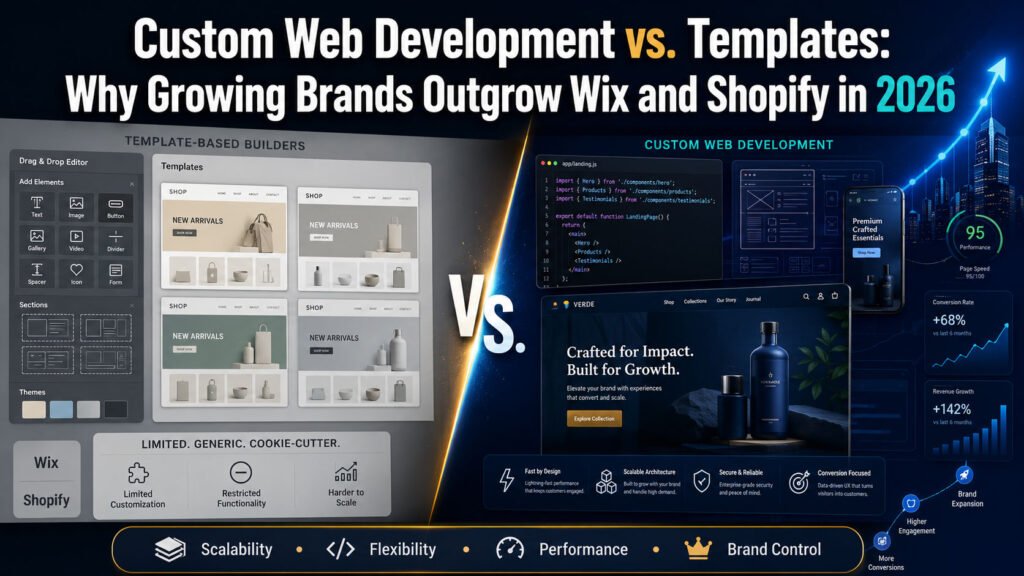
Template builders are brilliant at one thing: getting you online fast. Wix, Squarespace, and off-the-shelf Shopify themes let a brand-new business launch a decent-looking site in a weekend, and for that stage of the journey, they are genuinely the right tool.
But here is what nobody tells you when you sign up: templates are built for starting, not for scaling. Somewhere between your first sale and your first serious growth phase, the platform that once felt liberating starts feeling like a rented apartment with rules on every wall. Slower pages, plugin bloat, cookie-cutter design, SEO ceilings, and a checkout flow you cannot fully control. In 2026, with Google’s page experience standards tighter than ever and AI search engines rewarding fast, well-structured sites, those limitations are not cosmetic, they cost you rankings, conversions, and revenue.
Quick Answer: Templates on Wix or Shopify are ideal for launching, but growing brands typically outgrow them when they need faster load speeds, custom functionality, advanced SEO control, unique design, and third-party integrations that templates cannot deliver. Custom web development removes those ceilings, giving you a site built around your business instead of a business squeezed into a template.
The Honest Case for Templates (And Where It Ends)
Let’s be fair to the builders. Templates win on upfront cost, launch speed, and simplicity. If you are validating an idea, testing a market, or running a small side business, a template site is a smart, low-risk starting point. We tell clients this ourselves.
The problem is not that templates are bad. The problem is that every template is designed for the average business, and your growing brand is no longer average. The moment your needs become specific, a custom booking flow, a unique product configurator, a content structure built for AI search, a design that actually looks like your brand instead of theme #4471, you have hit the edge of what a template was ever meant to do.
7 Signs Your Brand Has Outgrown Its Template in 2026
1. Your Site Speed Is Costing You Rankings and Sales
Template sites carry code for thousands of businesses’ possible needs, which means yours loads scripts it never uses. Add a dozen apps and plugins, and Core Web Vitals suffer. In 2026, page experience is a ranking factor, and every extra second of load time measurably increases bounce and abandoned carts. Custom development ships only the code your site actually needs, which is why custom builds routinely outperform template sites on speed.
2. You Look Like Your Competitors
Popular themes are popular, which means the same layouts, the same hero sections, and the same fonts across your entire industry. When a visitor cannot tell your brand from three competitors in a blind test, design has stopped working for you. Custom design is built from your brand identity outward, not from a theme inward.
3. You’re Paying an App Stack Instead of Owning Features
Template limitations get patched with apps: one for reviews, one for search, one for upsells, one for forms. Each adds a monthly fee, extra scripts, and another point of failure. Many growing stores quietly spend hundreds per month renting features a custom build would simply own. Over two or three years, the “cheap” template often costs more than the custom site would have.
4. SEO and AEO Ceilings Are Holding You Back
Growing brands in 2026 are optimizing not just for Google, but for AI answer engines. That demands clean semantic markup, full schema control, fast rendering, and flexible content architecture, exactly the areas where template platforms restrict access. Custom development gives your team full control over structure, structured data, and technical SEO, so your content can compete for featured snippets and AI citations instead of fighting the platform.
5. Your Checkout or Lead Flow Can’t Match How You Actually Sell
Subscriptions, custom quotes, multi-step bookings, wholesale pricing, regional logic, financing options: real businesses sell in ways templates never anticipated. Forcing your sales process into a template’s checkout means friction, and friction means lost revenue at the exact moment a customer decided to buy.
6. Integrations Have Become Duct Tape
CRM, ERP, inventory, email automation, loyalty programs, shipping logic: growth means systems, and systems need to talk to each other. Templates offer whatever integrations their marketplace happens to support. Custom development connects your website to your actual operations through proper APIs, eliminating the manual workarounds your team has learned to live with.
7. Every ‘Small Change’ Requires a Workaround
If your last five website ideas all ended with “the theme doesn’t support that,” your platform is now making business decisions for you. That is the clearest sign of all.
Sound familiar? Design Innovacia builds custom, SEO-ready websites and e-commerce platforms for growing brands across the USA, Canada, and the UK. Call +1 (307) 487-8585 or email contact@designinnovacia.com for a free website audit and honest recommendation.
What Custom Web Development Actually Gets You
- Performance by design: lean, purpose-built code that passes Core Web Vitals and loads fast on real-world mobile connections.
- A design that is unmistakably yours: built from your brand strategy, not adapted from a theme thousands of others use.
- Full SEO and AEO control: clean heading hierarchy, custom schema, fast rendering, and content structures built to win search and AI answers.
- Features you own: custom functionality replaces the monthly app stack, lowering long-term costs and removing third-party risk.
- Scalability: an architecture that grows with traffic, catalog size, and new markets instead of buckling under them.
- Conversion-first UX: every page engineered around your funnel, with clear messaging and CTAs that turn visitors into qualified leads.
Wait — Can’t I Just Customize My Shopify Store?
Often, yes, and this surprises people: leaving a template does not always mean leaving your platform. Shopify itself is a powerful commerce engine; it is the off-the-shelf theme that creates the ceiling. Custom Shopify theme development, headless builds, and custom app development let growing stores keep Shopify’s checkout and infrastructure while getting fully bespoke design, speed, and functionality. As a team that delivers both custom web development and professional Shopify development, Design Innovacia will recommend the path that fits your growth, not the one that fits a sales pitch.
What Does Custom Web Development Cost in 2026?
Custom builds range widely because scope ranges widely: a conversion-focused business website is a different project than a custom e-commerce platform with ERP integration. Rather than quoting fantasy numbers, think in terms of return: template costs recur forever (subscriptions, apps, workarounds, lost conversions), while a custom site is an asset you own that compounds through better rankings, faster pages, and higher conversion rates. Most small business projects complete within 2 to 6 weeks, with complex e-commerce builds taking longer for proper optimization and testing. A transparent, fixed-scope quote tells you exactly what your project costs before work begins.
Frequently Asked Questions
When should I switch from Wix or a template to a custom website?
Switch when the platform starts limiting revenue: slow pages, SEO restrictions, design sameness, growing app costs, or features your business needs that the template cannot support. If you are working around your website instead of with it, you are ready.
Is custom web development better for SEO than Wix or Shopify templates?
Yes, in the areas that matter most for 2026: site speed, clean code, full schema control, and flexible content architecture. Templates limit technical SEO access; custom development removes those limits, which also positions your content better for AI-driven answer engines.
Will I lose my content and rankings if I move to a custom website?
Not with a professional migration. Proper redirects, preserved URL structures where sensible, and pre-launch SEO checks protect your rankings. Handled correctly, most brands see rankings improve after migration thanks to faster, cleaner architecture.
Can I keep Shopify but get a custom design?
Yes. Custom Shopify theme development gives you a fully bespoke storefront on Shopify’s proven commerce infrastructure. It is often the ideal middle path for growing stores that love Shopify’s checkout but have outgrown their theme.
How long does a custom website take to build?
Most small business websites complete within 2 to 6 weeks depending on scope, features, and revisions. Larger e-commerce and integration-heavy projects take longer to allow for proper development, optimization, and testing before launch.
Build the Website Your Growth Deserves
Templates got you here. They will not get you where you are going. If your brand is generating real traction, your website should be your hardest-working salesperson, not your most stubborn bottleneck. Design Innovacia has spent years building custom, high-converting websites and e-commerce platforms for growing brands, with SEO best practices baked into every build and a track record clients rave about.
Get a free, no-pressure website audit from Design Innovacia. We’ll show you exactly where your template is costing you and what a custom build would change. Call +1 (307) 487-8585 | contact@designinnovacia.com | designinnovacia.com
