

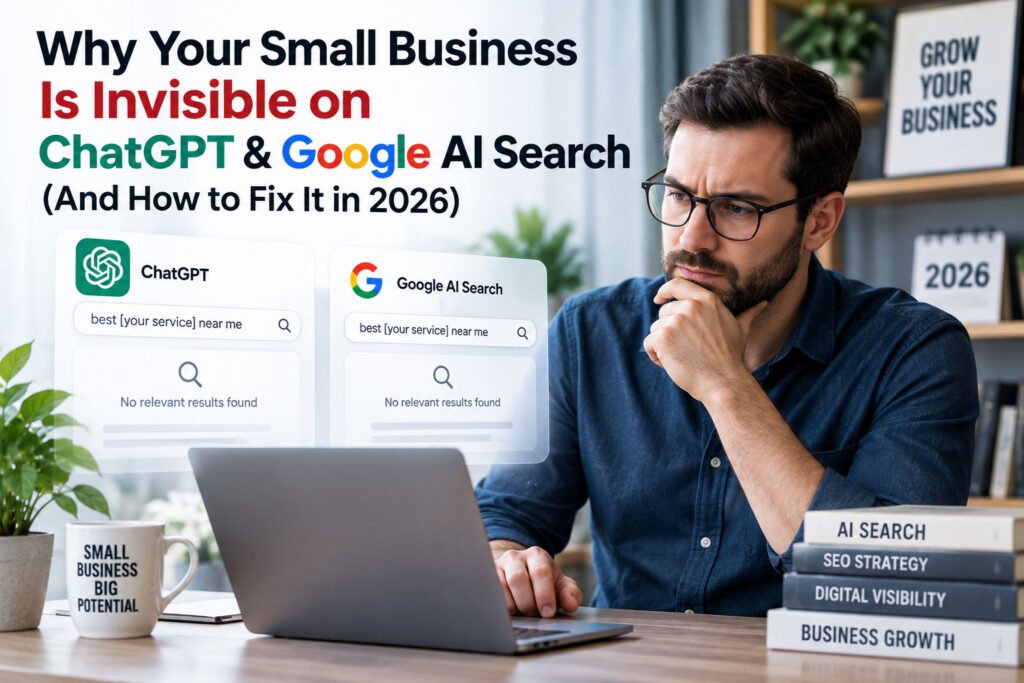
Your customers have changed how they search — but has your website?
A growing number of people no longer type a question into Google and scroll through ten blue links. They ask ChatGPT, Google’s AI Overviews, Perplexity, or Gemini a direct question — “best plumber near me,” “which local bakery does custom cakes,” “top web design company for small business” — and they get one confident, ready-made answer. No scrolling. No comparing tabs. Just a name, and sometimes a link.
If your business isn’t the name the AI mentions, you don’t just lose a click. You lose the customer entirely, because they may never see a traditional search results page at all.
This is the new reality small business owners are waking up to in 2026, and it has a name: AI Search Optimization, often called GEO (Generative Engine Optimization). It sits alongside traditional SEO, but it plays by different rules — and most small business websites simply aren’t built for it.
Here’s what’s actually happening, why your business might be invisible to AI right now, and the practical steps you can take to fix it.
What Is AI Search, and Why Should You Care?
AI search is any tool that answers a question directly instead of just linking to websites — ChatGPT with browsing, Google’s AI Overviews, Microsoft Copilot, Perplexity, and Gemini are the biggest examples. Instead of ranking ten websites, these tools read across many sources, pick the most trustworthy and clearly written ones, and summarize an answer for the user in seconds.
For a small business, this changes everything about how you get discovered:
- There’s often only one answer shown, not ten. Being “on page one” isn’t good enough anymore — you need to be the source the AI actually trusts and quotes.
- AI tools favor clear, well-structured, factual content over flashy design or clever slogans.
- Reviews, business listings, and mentions across the web now matter as much as your own website content, because AI cross-checks multiple sources before recommending you.
In short: AI search rewards businesses that are easy to understand, easy to verify, and consistently described the same way everywhere online — and it quietly skips over businesses that aren’t.
The Real Reason Most Small Business Sites Get Skipped
Most small business owners assume they’re invisible to AI because they’re “too small” to compete. In reality, it usually comes down to a handful of fixable problems:
- Thin or vague content. A homepage that says “Welcome to ABC Services, we do great work” gives an AI nothing concrete to quote or recommend.
- No structured data. AI tools rely heavily on schema markup — hidden code that tells search engines exactly what your business is, what you sell, and where you’re located. Without it, even a good website can go unread.
- No direct answers to real questions. AI favors content written the way people actually ask questions (“how much does a custom logo cost,” “do you offer same-day website fixes”) over generic marketing copy.
- Outdated or slow websites. Sites that load slowly, aren’t mobile-friendly, or haven’t been touched in years signal low trust to both Google and AI crawlers.
- Inconsistent information. If your business name, address, or phone number differs across your website, Google Business Profile, and directories, AI tools treat you as less reliable.
- Few or no credible mentions elsewhere. AI cross-references other websites, reviews, and directories. A business that only exists on its own homepage looks less trustworthy than one referenced across the web.
None of these are about being “too small.” They’re about whether your online presence is built the way AI systems are designed to read it.
Traditional SEO vs. AI Search Optimization: What’s Different
Traditional SEO was about ranking a page. AI search optimization is about becoming the answer — which means the strategy shifts:
- Traditional SEO chases keywords and rankings. AI search optimization chases clarity, structure, and trust signals.
- Traditional SEO can lean on backlinks alone. AI search optimization also needs schema markup, FAQ-style content, and consistent business data across the web.
- Traditional SEO rewards long-standing domains. AI search optimization rewards content that directly and accurately answers a real question, even from newer sites — if it’s structured correctly.
- Traditional SEO is largely about your own website. AI search optimization also depends on what other sites, directories, and reviews say about you.
The good news: none of this requires a massive budget. It requires the right structure, done properly, once — and maintained.
7 Steps Small Business Owners Can Take Right Now
- Rewrite key pages to answer real questions. Instead of “Our Services,” use headings like “How much does website design cost for a small business?” and answer them directly and honestly in the first sentence.
- Add schema markup to your site. This structured code tells AI exactly what your business does, your hours, pricing range, and service area — it’s one of the highest-impact, most overlooked fixes.
- Build a genuine content and blog strategy. Regular, well-written articles on topics your customers actually search for build the topical authority AI tools look for before recommending a business.
- Optimize and actively manage your Google Business Profile. It’s one of the most trusted data sources AI search tools pull from — keep it complete, accurate, and updated with fresh photos and posts.
- Earn mentions and reviews across the web. Local directories, industry sites, and genuine customer reviews all act as trust signals that confirm what your website claims.
- Make your website fast and mobile-first. AI and search crawlers deprioritize slow, clunky, outdated sites — and so do customers.
- Keep your business information identical everywhere. Same name, same address, same phone number, on your website, socials, and every directory listing.
Why DIY Often Falls Short
Every one of these steps is doable — but done properly, they take real technical skill and ongoing time: writing schema markup correctly, producing genuinely useful content week after week, monitoring listings across dozens of directories, and rebuilding a website that’s actually fast and structured the right way. Most small business owners are already running the business itself; AI search optimization becomes the task that keeps getting pushed to “next month.”
That’s the gap where a lot of small businesses quietly lose ground to competitors who got this right early.
How Design Innovacia Helps You Get Found — By AI and By Real Customers
This is exactly the work our team focuses on. Design Innovacia builds and optimizes small business websites that are fast, mobile-first, and structured correctly from day one — with the schema markup, clear service pages, and content foundation that both Google and AI search tools are built to trust.
Beyond web development, our SEO services and content writing team craft the FAQ pages, blog content, and structured answers that AI tools pull from, while our branding, social media marketing, and PPC services build the consistent presence across the web that turns “found” into “chosen.” Whether you need a brand-new website built the right way or an SEO and content refresh for the one you already have, we handle the technical and creative work so you can stay focused on running your business.
If you’re not sure where your business currently stands with AI search, that’s the easiest place to start — a quick conversation with our team can tell you exactly what’s missing.
Frequently Asked Questions
What is AI search optimization (GEO)?
It’s the practice of structuring your website and online presence so AI tools like ChatGPT, Google AI Overviews, and Perplexity can understand, trust, and recommend your business when someone asks a related question.
Do I need a brand-new website to show up in AI search results?
Not always. Many older websites can be optimized with better content, schema markup, and speed improvements. A rebuild is usually only necessary if the site is very outdated, slow, or not mobile-friendly.
How long does it take to start appearing in AI-generated answers?
It varies by industry and competition, but most businesses see meaningful movement within a few months of consistent optimization — similar to traditional SEO timelines, sometimes faster for well-structured local businesses.
Is AI search replacing traditional Google SEO?
Not replacing — layering on top of it. Strong traditional SEO fundamentals (speed, mobile-friendliness, backlinks, clear content) still matter and now feed directly into how AI tools evaluate your business.
Can a small business owner do this without an agency?
Yes, with enough time and technical knowledge. Most owners find it more practical to have a team handle the technical setup once and manage content and listings ongoing, so they aren’t relearning a shifting landscape alone.
The Bottom Line
AI search isn’t a future trend small businesses can plan for later — it’s already shaping who gets picked and who gets skipped, right now, every day. The businesses that show up in these answers aren’t necessarily the biggest ones. They’re the ones whose websites are clear, structured, consistent, and genuinely helpful.
Get your foundation right, and you’re not just chasing search rankings anymore — you’re becoming the answer AI gives your next customer.
Ready to see where your business stands? Talk to Design Innovacia’s team for a free consultation on your website, SEO, and AI search readiness.
