

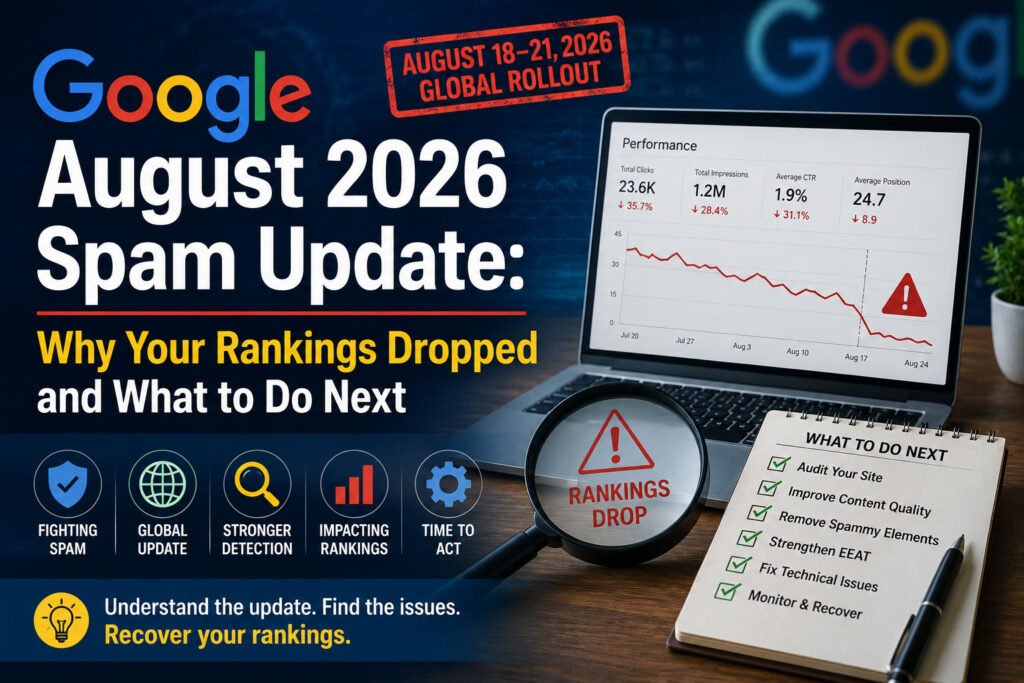
How to confirm the update actually hit you, what these updates target, and the recovery steps that work. Plus the panic reactions that make things worse.
| THE SHORT ANSWER Google announced a spam update beginning [VERIFY: rollout start date, from Google Search Status Dashboard]. Spam updates target violations of Google’s published spam policies, which is a different thing from a core update reassessing content quality. Before assuming the update caused your drop, confirm the timing lines up in Search Console, check whether the decline is site wide or limited to specific pages, and rule out technical problems and manual actions first. If the update did hit you, recovery generally requires fixing the underlying policy violation and then waiting for a subsequent update, which typically means months rather than weeks. Deleting content in a panic, disavowing links reflexively, or rewriting everything at once will usually make the situation worse rather than better. |
Traffic falls off a cliff on a Tuesday. You check analytics twice, assume it is a tracking error, then find a forum thread confirming that a Google update is rolling out.
What follows for most site owners is a week of panicked activity: deleting pages, rewriting content, disavowing backlinks, changing things at random in the hope that something works. Almost none of it helps, and some of it causes lasting damage.
Here is the ordered version. How to confirm the update actually caused your drop, what spam updates target, and what recovery genuinely involves.
What is a spam update, and how is it different from a core update?
These get used interchangeably and are not the same thing. The distinction matters because the recovery path is completely different.
A core update is a broad reassessment of how Google evaluates content quality and relevance. Nobody is being penalised. Sites move up and down because the assessment changed, and recovery involves genuinely improving the content and the site rather than removing anything.
A spam update targets content and tactics that violate Google’s published spam policies. This is closer to enforcement. If a spam update hit your site, something on it is being identified as matching a pattern Google has explicitly said it does not want in search results.
| Core Update | Spam Update | |
| What it does | Reassesses quality and relevance broadly | Enforces published spam policies |
| Who is affected | Very wide range of sites | Sites matching specific spam patterns |
| Is it a penalty | No | Effectively yes, though algorithmic |
| Recovery path | Improve content genuinely | Remove or fix the violating practice |
| Recovery timing | Often next core update | Often next spam update |
| Appears in Search Console | No notification | No notification unless manual action |
First, confirm the update actually caused it
A surprising share of drops attributed to updates were caused by something else entirely that happened around the same time. Work through this before changing anything on the site.
1. Check the exact date. In Search Console, compare the 28 days before and after. If the decline started days before the rollout began, the update is not your cause.
2. Determine the scope. Is every page down, or a specific section? Site wide decline suggests an update or a technical issue. A single section suggests a problem with that section.
3. Separate impressions from clicks. Impressions falling means you lost visibility. Impressions holding while clicks fall means you kept positions but lost the click, which points at SERP layout changes or AI answers rather than a ranking drop.
4. Check the Manual Actions report. If there is a manual action, this is not an algorithmic update at all and the path is completely different, including a reconsideration request.
5. Rule out technical causes. A botched migration, a stray noindex tag, an expired certificate, a robots.txt change, a server issue, or a CMS update can all produce update shaped drops.
6. Check whether your competitors moved. If the sites above you are the same as before, something changed on your side specifically.
| What You See | Likely Cause | Where to Look |
| Sitewide drop starting on rollout date | The update | Search Console date comparison |
| Drop began before the rollout | Something else | Technical changes, migrations, server logs |
| One section down, rest stable | Section specific issue | That section’s content and links |
| Impressions steady, clicks down | SERP or AI answer changes | Position data and CTR by query |
| Notification in Search Console | Manual action | Manual Actions report |
| Gradual decline over months | Not an update | Content decay, lost links, competitors |
What spam updates target
Google publishes its spam policies openly, and spam updates enforce them. The categories that have driven recent enforcement are worth reviewing honestly against your own site.
Scaled content abuse
Producing large volumes of content primarily to manipulate rankings rather than to help people, regardless of how it was produced. The method is not the issue. Publishing two hundred thin articles that exist only to target keyword variations falls into this category whether a person or a tool wrote them.
Site reputation abuse
Sometimes called parasite SEO. Third party content published on an established domain to exploit that domain’s authority, with little oversight from the host site. Coupon sections on news sites and sponsored content sections operating independently of the main publication are the classic examples.
Expired domain abuse
Buying an expired domain that carries accumulated authority and repurposing it for unrelated content, in order to benefit from signals earned by the previous owner’s entirely different site.
Link spam
Buying or exchanging links to manipulate rankings, large scale guest posting purely for links, and automated link building. This has been enforced for years and continues to be.
Doorway pages
Large sets of near identical pages built to capture location or keyword variations, funnelling users to the same destination. The classic pattern is hundreds of city pages differing only by the city name, which is worth noting because plenty of legitimate businesses have built exactly this without realising it is a policy violation.
[VERIFY: what Google specifically stated this update targeted, from the Search Central blog announcement. If Google named particular policies, name them here and quote the announcement directly. If Google gave no specifics beyond a general spam update, say so plainly rather than speculating.]
| THE HONEST SELF ASSESSMENT Read those five categories and answer one question truthfully: does anything on your site resemble any of them, even partially, even if it seemed reasonable when you did it? Most sites hit by spam updates were doing something the owner half knew was aggressive. The recovery starts with admitting which one it was. |
What to do in the first week
1. Do not change anything for the first few days. Updates take days or weeks to roll out fully and rankings fluctuate during that period. Changes made mid rollout make it impossible to know later what caused what.
2. Document the baseline. Export Search Console data for the 90 days before the drop, by page and by query. You cannot measure recovery without a record of what you lost.
3. Identify exactly which pages and queries lost the most. Recovery work is targeted, not site wide.
4. Audit those specific pages against the spam policy categories above, honestly rather than defensively.
5. Check your backlink profile for anything acquired through purchase, exchange or scaled guest posting, particularly if a previous agency handled it and you never reviewed what they did.
6. Fix the underlying issue rather than the symptom. Removing thin content helps only if thin content was the problem. If it was links, deleting pages does nothing.
What not to do
- Do not mass delete content in a panic. Removing pages that were not the problem loses whatever rankings and links they held, and those do not come back easily.
- Do not disavow links reflexively. The disavow tool is for links you cannot remove that you or someone acting for you built. Disavowing organically earned links actively harms you, and Google has repeatedly said most sites never need it.
- Do not rewrite everything simultaneously. Rewriting a hundred pages at once means that if rankings move, you will never know which change caused it. Work in identifiable batches.
- Do not expect recovery within days. Recovery is not immediate and it is not linear. Watching rankings hourly leads to changing things too often to learn anything.
- Do not hire someone promising a fast fix. Anyone guaranteeing recovery from a Google update by a specific date is describing something nobody can deliver.
| Not sure whether the update hit you or something else did? Design Innovacia diagnoses ranking drops for businesses across the US, Canada and the UK, starting with whether the update was actually the cause. We tell you what happened before we tell you what it costs to fix. Request a ranking drop diagnosis at designinnovacia.com |
How long does recovery take?
This is where honest answers matter more than reassuring ones.
If you were hit by a spam update, fixing the violation does not restore rankings immediately. The assessment that demoted you was applied algorithmically, and in most cases it gets reassessed when a subsequent update runs. That means recovery timing is tied to Google’s release schedule rather than to how quickly you complete the work.
Practically, that usually means months. Sites that fix a genuine violation thoroughly often see recovery at the next relevant update. Sites that make cosmetic changes generally see nothing, because the underlying pattern is still there.
| Situation | Realistic Timeline | What Determines It |
| Manual action, resolved | Weeks | Reconsideration request review time |
| Spam update, violation fixed | Months | Timing of the next relevant update |
| Spam update, partially fixed | Indefinite | The remaining pattern is still detected |
| Technical issue, corrected | Days to weeks | Recrawl and reindex speed |
| Core update, content improved | Months | Next core update |
| Not actually an update | Varies | Whatever the real cause was |
The uncomfortable truth some sites have to accept is that full recovery does not always happen. A site whose rankings depended substantially on a practice Google now enforces against may never return to its previous position, because that position was built on something that no longer works. In those cases the productive path forward is building traffic on a foundation that is not at risk, rather than continuing to chase what was lost.
Frequently asked questions
Why did my Google rankings drop?
Common causes are a Google algorithm update, a technical problem such as an accidental noindex tag or a failed migration, a manual action, changes in the search results layout that reduce clicks without changing position, or competitors improving. Before assuming it was an update, compare the exact dates in Search Console, check whether the decline is site wide or limited to certain pages, and review the Manual Actions report.
What is the difference between a Google spam update and a core update?
A core update broadly reassesses how content quality and relevance are evaluated, moving many sites up and down without any site being penalised. A spam update enforces Google’s published spam policies against sites using tactics Google has explicitly identified as manipulative. Recovery from a core update means genuinely improving content. Recovery from a spam update means removing or fixing the violating practice.
How do I know if a Google update hit my site?
Compare your Search Console traffic in the 28 days before and after the announced rollout dates. A decline that begins on or shortly after the rollout start, affects a broad set of pages, and shows falling impressions rather than just falling clicks, is consistent with an update. A decline that began before the rollout, or is confined to one section, usually has a different cause.
How long does it take to recover from a Google spam update?
Generally months rather than weeks. Fixing the underlying violation does not restore rankings immediately, because the demotion was applied algorithmically and is typically reassessed when a subsequent update runs. Recovery timing therefore depends on Google’s release schedule as much as on how fast you complete the work. Manual actions are different and can be resolved in weeks through a reconsideration request.
Should I disavow backlinks after a spam update?
Usually not. The disavow tool is intended for links you or someone acting on your behalf built that you cannot get removed. Google has repeatedly stated that most sites never need it, and disavowing organically earned links can actively harm your rankings. Review your profile first, and only consider disavowing if you find a clear pattern of paid, exchanged or scaled link building.
Can deleting content help recover from a spam update?
Only if thin or scaled content was the actual problem. Deleting pages that were performing well loses their rankings, their links and their traffic, and that is difficult to reverse. Diagnose the cause before removing anything, and if content is the issue, work in identifiable batches so you can tell what caused any subsequent movement.
| Rankings recover faster when somebody diagnoses before they act. Design Innovacia provides SEO, technical audits and answer engine optimization for businesses across the US, Canada and the UK. If traffic dropped and nobody can tell you why, that is where we start. Book a diagnosis at designinnovacia.com |
