

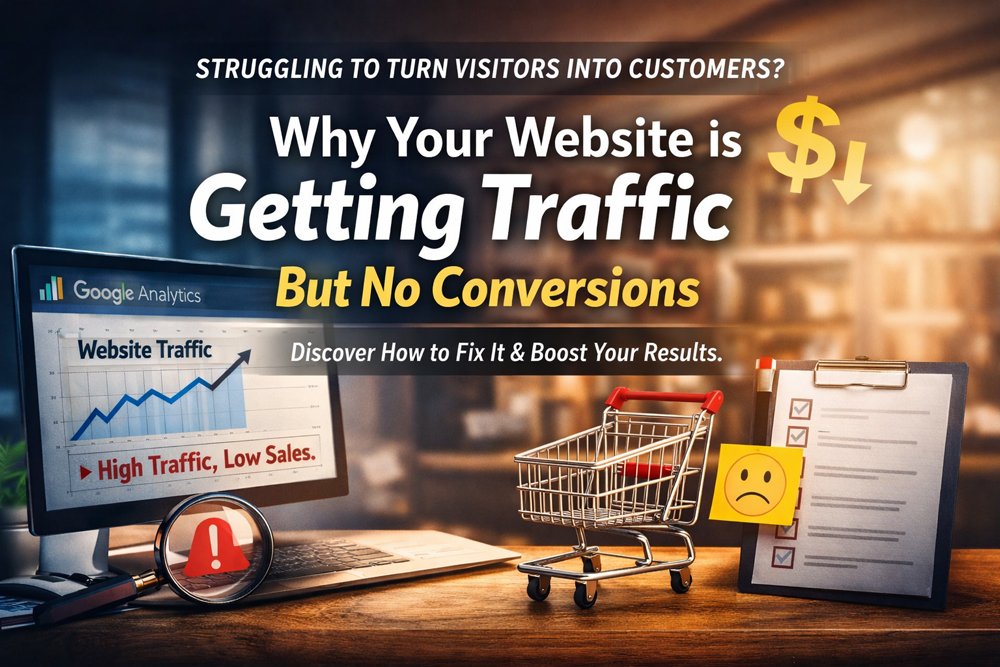
Getting traffic to your website feels like progress. You check Google Analytics and see visitors coming in. Your SEO campaign is generating impressions. Your ads are producing clicks. On the surface, everything looks like it’s working.
But there’s one frustrating problem — those visitors are not converting into leads, inquiries, or sales.
If your website traffic is increasing but revenue is not, you are facing a conversion problem, not a traffic problem.
This situation is extremely common in 2026. Businesses invest in SEO and paid ads but forget to optimize the most important part of the funnel — what happens after someone lands on the website.
In this guide, we’ll break down the real reasons your website is getting traffic but not converting — and provide clear, practical solutions you can implement immediately.
1. You’re Attracting the Wrong Type of Traffic
Not all traffic is equal.
Many websites rank for high-volume informational keywords but fail to target buyer-intent search terms. That means people are visiting your site to learn, not to buy.
For example:
- “What is SEO?” → informational
- “Best SEO agency near me” → commercial intent
- “How to build a website” → research intent
- “Website redesign services in Toronto” → purchase intent
If your content mainly targets research-based queries, you will see traffic but very few conversions.
Signs You’re Attracting the Wrong Traffic
- High traffic but low inquiry rate
- Low average time on service pages
- Traffic coming from unrelated regions
- Blog posts ranking but service pages’ not
How to Fix It
Shift your SEO strategy toward commercial keywords such as:
- SEO services for small businesses
- Website development agency
- Ecommerce conversion optimization
- Local SEO company near me
Traffic quality always matters more than traffic volume.
2. Your Website Messaging Is Too Generic
Visitors decide within 3–5 seconds whether they trust your business.
If your homepage headline says something vague like:
“We Provide Digital Solutions.”
That doesn’t communicate value.
Your messaging must instantly answer:
- What do you do?
- Who do you help?
- What result do you deliver?
When messaging lacks clarity, visitors leave because they don’t immediately understand how you solve their problem.
Example of Weak Messaging
- “We Help Businesses Grow.”
- “Your Partner in Innovation.”
These sound nice — but they are not specific.
Example of Strong Messaging
We Help Small Businesses Generate More Leads Through SEO & High-Converting Websites.
Clear messaging increases confidence and keeps visitors engaged.
3. Weak or Hidden Call-to-Action (CTA)
Even interested visitors won’t take action unless you guide them.
Many websites bury their CTA at the bottom or use passive language like:
- Submit
- Learn More
- Click Here
These do not create urgency or motivation.
High-Converting CTA Examples
- Get Your Free Website Audit
- Book Your Strategy Call Today
- Request a Custom Quote
- Start Growing Your Business Now
Your CTA should:
- Appear above the fold
- Repeat throughout the page
- Use action-driven language
- Be visually distinct
The clearer the next step, the higher the conversion rate.
4. Poor User Experience (UX) Is Killing Conversions
User experience plays a massive role in conversions.
If your website:
- Loads slowly
- Feels cluttered
- Has confusing navigation
- Is not mobile-friendly
Visitors will leave — even if they were interested.
In 2026, users expect:
- Clean layouts
- Fast loading times
- Professional design
- Simple navigation
Common UX Problems That Reduce Conversions
- Too many animations
- Overcrowded sections
- Tiny mobile buttons
- Hard-to-read fonts
- Popups blocking content
Even a 2–3 second delay in load time can significantly increase bounce rate.
5. You Don’t Have Enough Trust Signals
People rarely buy from websites they don’t trust.
If your website lacks proof, conversions drop.
Trust signals include:
- Google reviews
- Client testimonials
- Case studies
- Before-and-after results
- Industry certifications
- Security badges
When visitors see real results and client experiences, their hesitation decreases.
Trust reduces risk.
Risk reduction increases conversions.
6. Your Offer Isn’t Compelling Enough
Sometimes the issue isn’t traffic or design — it’s your offer.
If visitors don’t see a strong reason to act now, they postpone the decision.
A strong offer includes:
- Clear pricing transparency
- Free consultation
- Limited-time bonuses
- First-time discounts
- Clear value breakdown
Without a compelling reason, even interested users leave “to think about it.”
7. Mobile Optimization Is Weak
Over 70% of traffic today comes from mobile devices.
If your mobile experience is frustrating, you’re losing the majority of your potential conversions.
Check:
- Are buttons easy to tap?
- Are forms simple to complete?
- Is text readable without zooming?
- Does the layout shift properly?
A broken mobile layout can destroy conversion rates silently.
8. You’re Not Tracking Conversion Behavior
Many businesses rely only on traffic metrics.
But traffic metrics don’t reveal conversion problems.
You need tools like:
- Google Analytics
- Google Search Console
- Microsoft Clarity
- Hotjar
Track:
- Scroll depth
- Drop-off points
- Heat maps
- Form abandonment
Data tells you where users hesitate or leave.
Without tracking, you’re guessing.
9. Your Content Focuses on Features Instead of Outcomes
Visitors don’t convert because of features.
They convert because of outcomes.
Instead of saying:
- “We offer advanced SEO strategies.”
Say:
- “We help you rank higher and generate qualified leads consistently.”
Instead of listing services, explain transformations.
People respond to solutions — not technical descriptions.
Step-by-Step Conversion Optimization Checklist
Here’s what you can implement immediately:
- Refine commercial keyword targeting
- Rewrite homepage messaging clearly
- Strengthen CTAs across all pages
- Improve mobile usability
- Add testimonials and proof
- Increase page speed
- Create a compelling offer
- Install behavior tracking tools
Small improvements in multiple areas create compound growth.
The Truth About Traffic vs Revenue
Traffic is visibility.
Conversions are profitability.
Many businesses celebrate ranking improvements but ignore conversion metrics.
If your website is not designed to convert visitors into customers, traffic becomes a vanity metric.
The real goal is sustainable growth.
How Design Innovacia Can Help
If your website is getting traffic but not generating leads, you don’t need more traffic — you need strategic conversion optimization.
At Design Innovacia, we specialize in:
- SEO-driven traffic growth
- Conversion-focused website design
- UX improvements
- Lead generation systems
- Performance audits
We analyze where users drop off and restructure your site for measurable growth.
